How to Hire a Subcontractor in South Carolina: A Builder’s Checklist
Published on
A subcontractor is a specialty company you contract to perform part of a job you are responsible for: the framing, the siding, the windows.
Hiring one well comes down to five steps, in this order: write the scope, check the sub’s registration against that scope, collect insurance proof on the day you hire, sign a subcontract, and plan the handoffs between trades.
The order matters more in South Carolina than most guides suggest. If your sub’s crew is uninsured and someone gets hurt, state law can put the workers’ compensation claim on you, unless you collected proof of coverage when you engaged the sub. The rest of this checklist is built around avoiding that kind of surprise.
What hiring a subcontractor means under South Carolina law
Who typically hires subcontractors? General contractors and builders, mostly, and sometimes property owners managing their own build.
South Carolina’s residential builders law defines a residential specialty contractor as an independent contractor who works for a licensed residential builder, a general contractor or an individual property owner, and it lists the trades: among them vinyl and aluminum siding installers, carpenters, roofers, masons and drywall installers (S.C. Code Title 40, Chapter 59, Section 40-59-20).
Two parts of that law shape how you hire.
First, a specialty contractor may not take on work outside the scope of its license or registration, including by subcontracting it to someone else.
Second, a contractor that was required to be licensed or registered and was not cannot file a mechanics’ lien or sue to enforce the contract (Section 40-59-30). Both rules reward checking the paperwork before the first board goes up.
1. Write the scope before you ask for a price
A price is only as good as the scope behind it. Before you call anyone, write down what the sub will build and what it will not. For a framing or exterior package that usually means:
- The plan set and revision date the price is based on.
- Which systems are in: wall, floor and roof framing; sheathing; weather barrier and flashing; windows and exterior doors set and flashed; trim; siding.
- Who buys the material, who receives it and where it is stored.
- Who orders inspections and who fixes what an inspector writes up.
- Cleanup, dumpster, temporary stairs and site access.
- Punch list and what “complete” means for the scope.
Two subs pricing two different scopes will give you two numbers that cannot be compared. The written scope is what makes the bids line up.
Where do the candidates come from? Usually from other builders, from the lumber yard and siding supplier, and from the local home builders association.
Send each one the same written scope, ask to see a job they have in progress, and call recent clients before you compare numbers. A bid that leaves out part of the scope is not the cheaper bid; it is a smaller job.
2. Check the registration against the work
Ask for the company’s license or registration with the South Carolina Residential Builders Commission and look it up yourself through the Department of Labor, Licensing and Regulation (SC LLR, Residential Builders Commission).
Then compare the classification with the scope you wrote. A siding registration does not cover framing an addition, and the law says specialty contractors cannot do additions without supervision by a residential builder or another appropriately licensed party.
If the sub will bring in its own sub, the same check applies one level down.
3. Collect insurance proof the day you hire, not the day of a claim
Under Sections 42-1-400 and 42-1-410 of the South Carolina Code, a contractor who hires a subcontractor can be liable for workers’ compensation owed to the subcontractor’s employees as if they were its own (S.C. Code Title 42, Chapter 1).
Section 42-1-415 is the protection, and it has conditions.
If the sub represented that it had workers’ compensation coverage when you engaged it, and you collected that documentation at the time of hire on a standard form acceptable to the Workers’ Compensation Commission, the law relieves you of that liability.
In that case you or your carrier pay the benefits first, then can ask the commission to move the claim to the state’s Uninsured Employers’ Fund and be reimbursed.
The same section makes it fraud for a sub to fail to tell you, by certified mail within five days, that its coverage lapsed.
In practice: get the coverage document before the crew arrives, keep it in the job file, and ask your own insurance agent what else your policy requires from subs, such as general liability limits or endorsements.
4. Put the deal in a subcontract
A short subcontract beats a long text thread.
It should name the scope from step 1 and the plan revision; the price basis and payment schedule; the start date, duration and what happens if the site is not ready; insurance and registration documents attached; warranty and callback terms for the sub’s work; cleanup and safety duties; and how changes are handled.
That last item causes most disputes. A change to the scope should be written, priced and signed before the work changes; we walked through how a change order works from request to signature.
For tax paperwork, ask for a Form W-9 before the first payment, since it gives you the taxpayer information you need for a Form 1099-NEC at year end (IRS, Form W-9; IRS, Form 1099-NEC). Your accountant confirms whether the 1099 applies to that company.
5. Plan the handoffs between trades
On a framed house, each trade starts from the work the last one left. The framer needs a foundation that is square and ready; the window installer needs openings framed to the rough opening sizes; the siding crew needs the weather barrier and flashing finished and inspected.
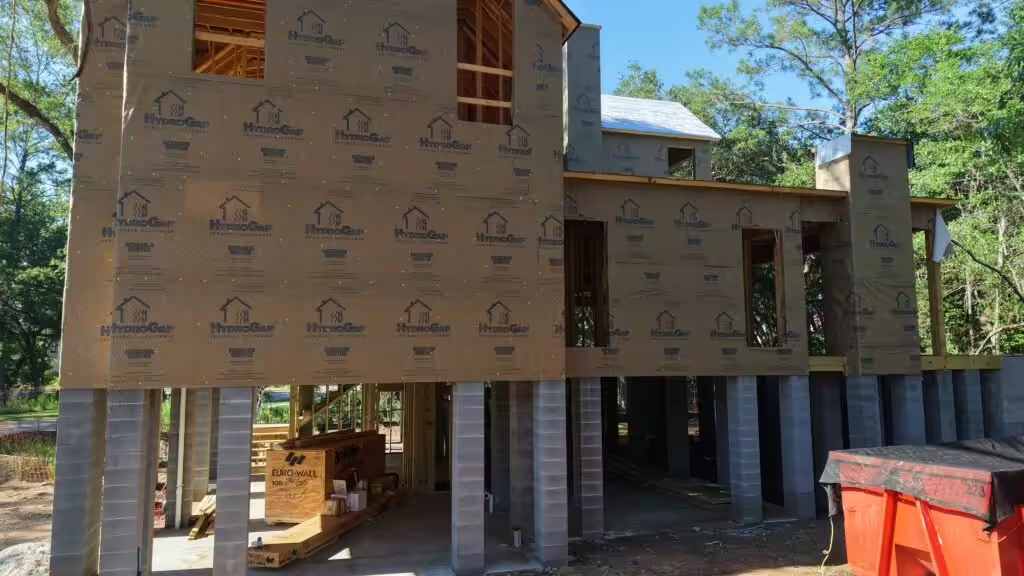
This Kiawah River house, photographed at the framing stage, shows what the next trade inherits: walls sheathed and wrapped, lumber still staged under the floor, the dumpster on site. Agree before the start who leaves the site in what condition, who books which inspection, and how the sub will know the area is ready.
The downsides of subcontracting, and how to limit them
The honest downsides are less direct control over the crew, more parties to coordinate, and the liability that follows uninsured or unregistered subs. Each step above answers one of them: the scope and subcontract set the control you do have, the handoff plan handles coordination, and the registration and insurance checks address the liability.
Subcontractor hiring checklist to print
- Written scope, with plan set and revision date
- Registration or license looked up with SC LLR, classification matches the scope
- Workers’ compensation documentation collected at hire, on a form acceptable to the commission
- General liability certificate and any endorsements your own insurer requires
- Form W-9 on file before the first payment
- Signed subcontract: price basis, payment schedule, start date and duration
- Change order process written into the subcontract
- Who orders inspections and who corrects write-ups
- Handoff conditions: what “ready” means for the sub, and what the sub leaves for the next trade
- One named contact on each side
What a subcontractor’s price depends on
How much do you pay a subcontractor? There is no honest single number, because the price follows the scope. These factors move it:
- Labor only, or labor and material.
- The size and complexity of the house: stories, roof lines, porches, openings.
- Foundation and access: raised homes on piers and tight island lots take more lifting and carrying.
- Wind design: engineered connectors and nailing schedules on coastal lots.
- Schedule pressure and how ready the site is when the crew arrives.
- How many changes come after the price is set.
The same process, seen from the subcontractor’s side
CHS Built works as a framing and siding subcontractor for builders and general contractors across the Lowcountry.
Our published process follows the same order as this checklist: we review your plans, scope and schedule, then put together written subcontractor pricing.
During the build we keep the GC updated, and at the end we walk the finished scope with you, handle punch-list items and hand the work back ready for the next trade. You get one point of contact for the job.
The same checks apply to us as to any sub, and you can see the work on our recent projects across the Lowcountry. When you have a plan set ready, start a conversation with CHS Built about your trade scope.
Keep reading